Key takeaways
Ontario PPSA registrations use a check-box collateral classification, so search results often appear broad but ambiguous.
Alberta PPSA registrations require a written collateral description, so search results usually show more detail.
Alberta's searches include a broader scope of registration types: they also captures writs of execution and certain bankruptcy and family proceedings.
On interprovincial deals, the same PPSA search can yield very different diligence value by province.
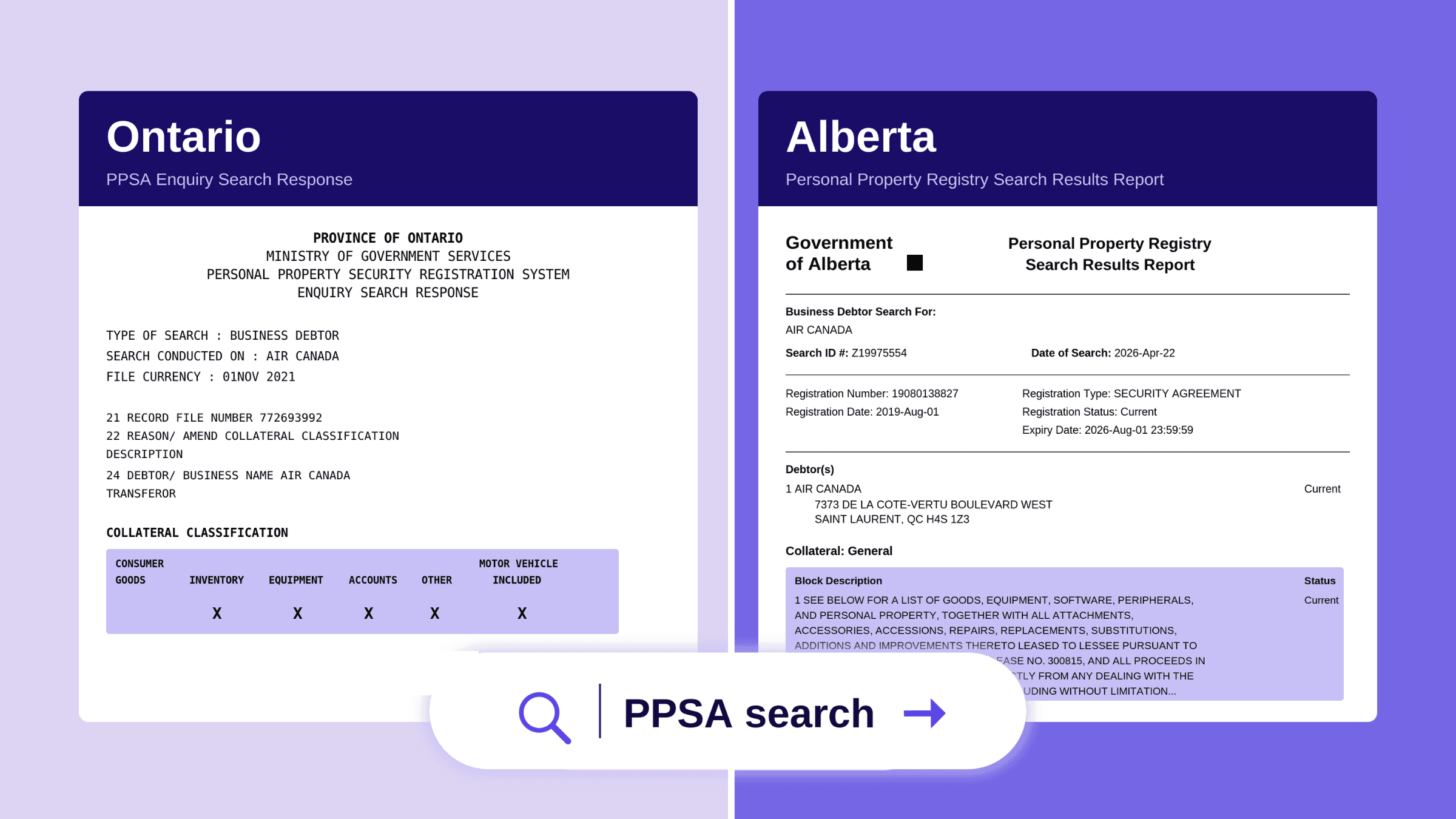
The information provided in a PPSA search in Alberta is very different than in Ontario.
In Ontario, PPSA search results can confirm that a registration exists while saying relatively little about the secured collateral itself. In Alberta, PPSA registrations have more explicit information, and the registry also captures types of registrations that must be searched elsewhere in Ontario - most notably writs of execution (i.e., judgments).
1. Why are Ontario PPSA search results often unclear?
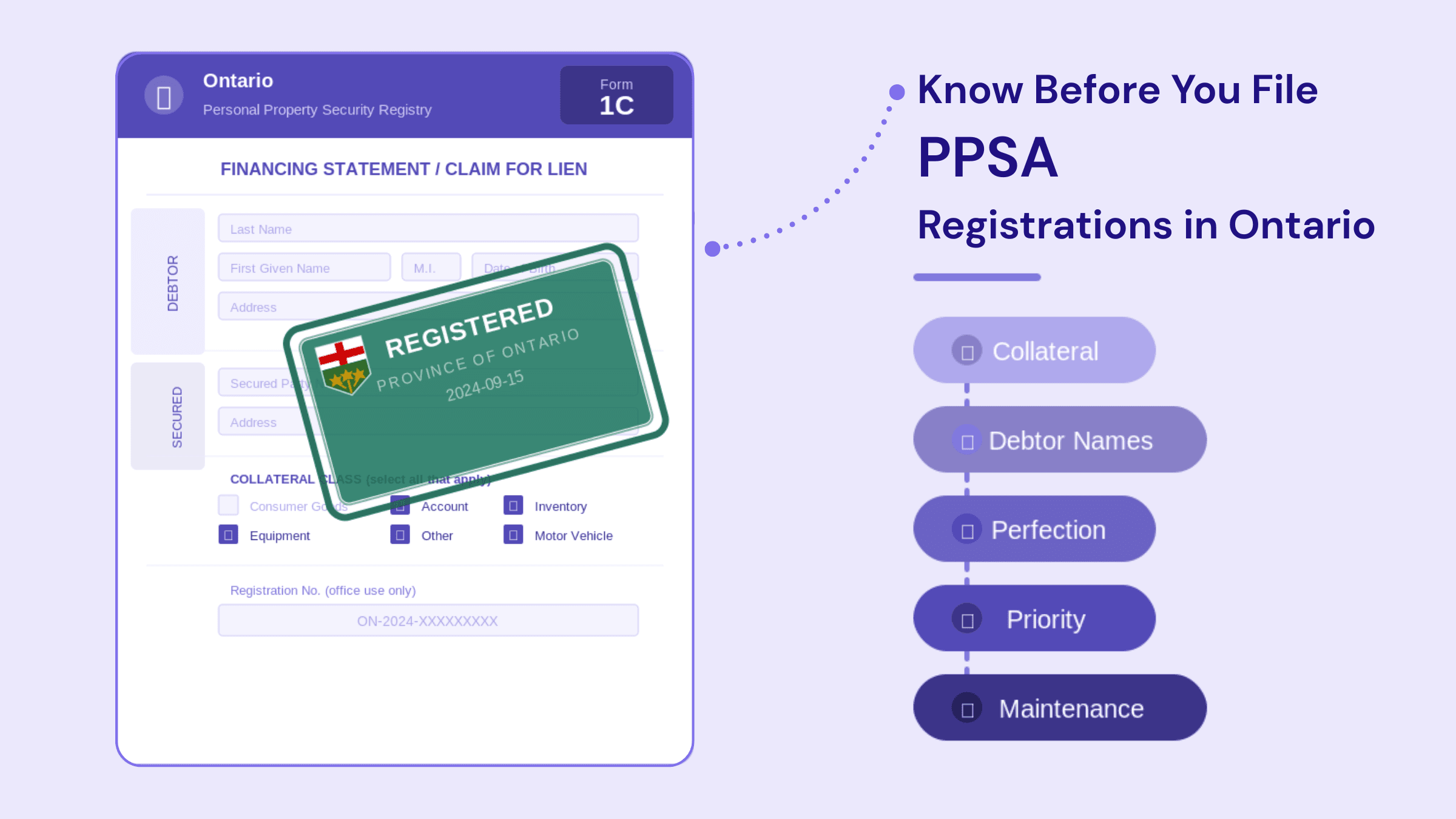
Ontario remains distinctive from all other Canadian jurisdictions because the Ontario PPSA system is built around a check box collateral classification (i.e., Consumer Goods, Inventory, Equipment, Accounts, Other and/or Motor Vehicle Included), while a general collateral description is optional.
This structure has an obvious effect on how helpful your PPSA search results will be in Ontario. A registration can be broad and perfected, but the search result may still leave the reader unsure about what assets are actually being secured - especially when the broad and ambiguous “other” collateral classification is selected. In practice, lawyers for secured parties often keep Ontario registrations broad by checking multiple collateral classes (including “other”) and adding no collateral description. From the secured party’s perspective, this avoids potentially narrowing your registration unnecessarily. From the searcher’s perspective, it often makes the PPSA search result less helpful and necessitates follow ups with the debtors and/or secured parties and related estoppel letters.
The check box collateral classification is a unique PPSA feature for Ontario . The search results will tell you clearly that a registration exists, but it will more than likely be ambiguous (without further inquiry) as to what collateral is secured.
2. Alberta PPSA search results have more detail by default
Alberta PPSA search results are generally more informative on their face.
One reason is the way APPRES (the PPSA system in Alberta) handles search matches. Alberta PPSA search results distinguish between exact and inexact matches. Exact matches are automatically included in the results. Inexact matches must be reviewed and actively detailed if the searcher wants their full registration details included; otherwise only a simple summary appears. This makes the Alberta report more explicit about what was found, whether from an exact match or inexact (i.e. similar) match.
Another major reason is that Alberta requires a collateral description for a PPSA registration - not just a check box collateral classification.
In practice, Alberta PPSA search results often give the reader a better picture of what are assets are secured compared a typical Ontario PPSA result.
3. What does an Alberta PPSA search include that Ontario does not?
Alberta also stands out because its PPSA registry captures more than standard security agreement registrations.
In Ontario, a PPSA search will show registrations registered under the PPSA and RLSA (Repair and Storage Liens Act). Writs of execution are separate searches conducted with the relevant enforcement offices.
In Alberta, however, writs of execution, certain bankruptcy proceedings and certain matrimonial/family proceedings are included in a PPSA search.
For anyone reviewing PPSA searches on a interprovincial deal - this difference is important. An Alberta PPSA search can reveal a broader registration history with the same search criteria.
4. Ontario vs. Alberta: The practical difference for PPSA searches
Ontario and Alberta PPSA searches create two different reading exercises.
In Ontario, the challenge is often interpreting and dealing with a result that is broad but not especially descriptive. In Alberta, the challenge is more often that the registry can return a broader and more detailed set of registrations, including registration types that would not appear in an Ontario PPSA search.
Neither approach is inherently better, they simply tell the searcher different things. The same is true across other Canadian jurisdictions - for a similar comparison, see how PPSA searches differ between Ontario and Nova Scotia.
5. Regy’s approach
When reviewing Ontario PPSA search results, it is often worth assuming that the secured collateral could be broader than expected, especially where the registration relies mainly on collateral classifications and gives little to no collateral description.
When reviewing Alberta PPSA search results, it is worth keeping in mind that the registry may reveal a broader set of registration types, and that the results can distinguish between exact and inexact results in a way that affects what is actually included.
The same debtor search can therefore produce very different diligence value depending on whether it was run in Ontario or Alberta.
Caveat: This is a comparison of what PPSA search results generally show. It is not a full comparison of the Ontario and Alberta PPSA statutes, regulations, or priority rules, which have their own differences as well.
The information provided on this website is for general information purposes only and does not constitute legal advice. It is not intended to be a substitute for legal advice from a qualified lawyer. Regy is not a law firm.