
Key takeaways
Ontario’s Individual Non-Specific search provides broader coverage
It captures results missed by searches using middle initial and date of birth
It is especially useful when information is incomplete or uncertain
Nova Scotia does not have this broad individual name option
Both Ontario and Nova Scotia return “similar” business name matches
Ontario uses strict rules-based matching
Nova Scotia uses NYSIIS phonetic matching plus rules and punctuation logic
A PPSA search is not uniform across Canada.
The search options and matching logic vary by registry, which can affect which search results are returned.
For example, there are two PPSA search options in Ontario when searching individuals - the Individual Specific search and the broader Individual Non-Specific search.
Conversely, Nova Scotia (and the other ACOL-based jurisdictions of NB, PEI, NL, NT, NU, and YT) uses a common phonetic-based search algorithm for “similar matches” called NYSIIS that considers variations such as Smith and Smyth, John and Jon, as “similar”.
How do individual PPSA name searches work in Ontario?
An Individual Specific search is narrow. It exactly matches on first name, middle initial (if any), last name, and date of birth. Therefore, a search conducted on WILLIAM SMITH 26 JUN 1952 will not include a registration filed against WILLIAM J. SMITH 26 JUN 1952.
The Individual Non-Specific search, on the other hand, ignores the middle initial and date of birth fields altogether, exactly matching the first name and last name fields only.
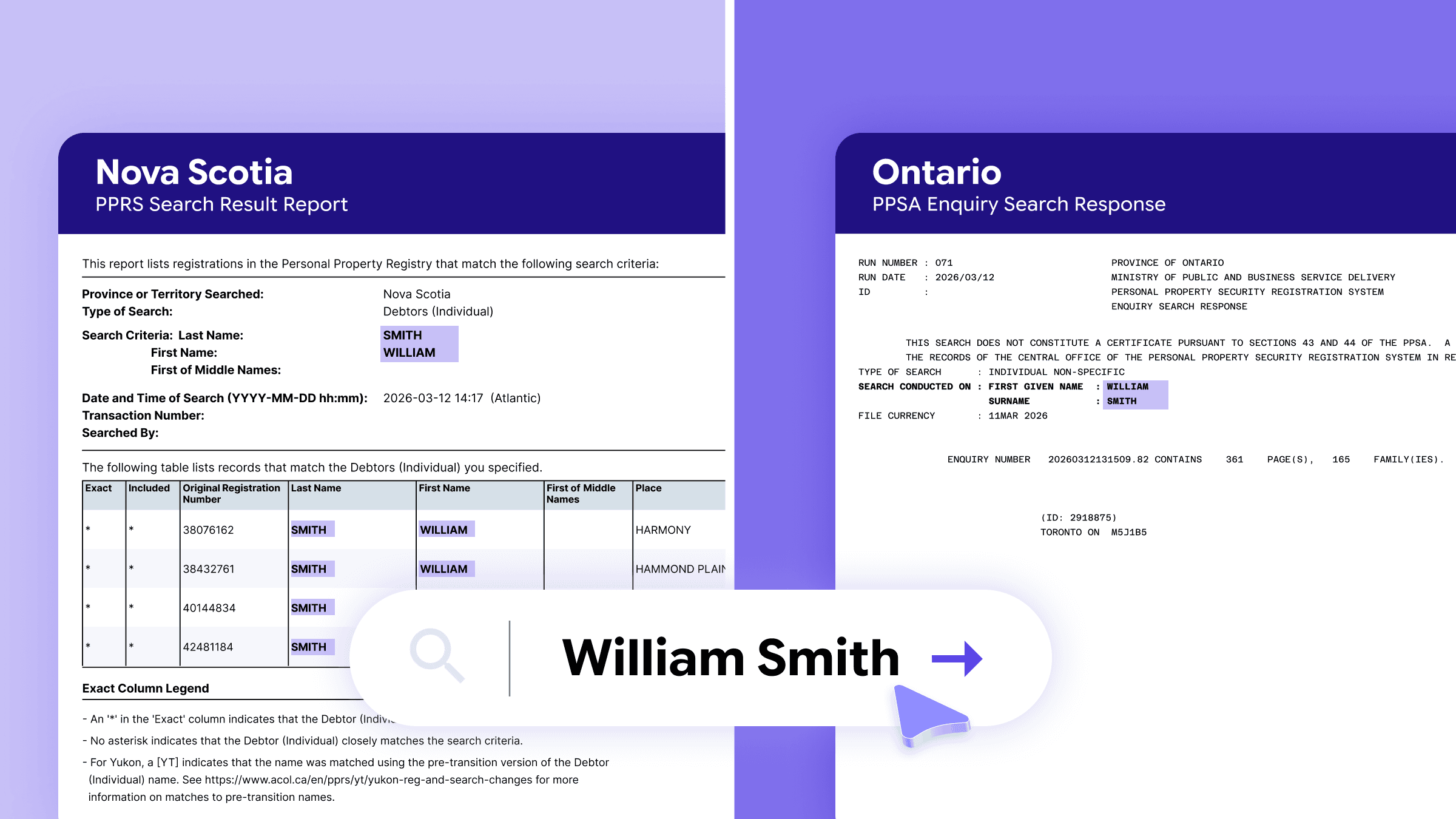
Therefore, a search conducted on WILLIAM SMITH will include registrations filed against:
WILLIAM A. SMITH;
WILLIAM R. SMITH 26 JUN 1952;
WILLIAM Q. SMITH;
WILLIAM J. SMITH 21 JUN 1950;
…and any other registrations filed against first name WILLIAM and last name SMITH, regardless of middle initial and date of birth.
However, it will not return registrations filed against any variation or alternative spellings, such as:
WILLIAM SMYTH; or
BILL SMITH
This makes Individual Non-Specific searches a practical option where the middle initial and/or date of birth is unknown or uncertain on a deal. It also means that an Individual Non-Specific search against a common name, such as WILLIAM SMITH, may return many unrelated hits that you’ll need to filter through. Regy’s automated summaries simplify this task, helping law clerks reduce time on high volume due diligence searches.
How do individual PPSA name searches work in Nova Scotia?
Nova Scotia searches individual names differently. There’s no option for adding date of birth - the search fields are first name, middle name (if any) and last name. Search criteria without a middle name do not match a registration with a middle name, and search criteria with a middle name do not match a registration without one. A search using first name, last name and only a middle initial can “similar match” a registered name where the first letter of the middle name begins with that letter, but this is still less broad than Ontario’s Individual Non-Specific search.
Nova Scotia’s “similar match” process is based on the NYSIIS algorithm (e.g., Smith and Smyth, and John and Jon, would respectively be “similar”), but the middle-name rules still apply.
Whereas an Ontario Individual Non-Specific search for WILLIAM SMITH will return registrations against:
WILLIAM Q. SMITH 26 JUN 1952; and
WILLIAM J. SMITH 11 JUL 1941,
a Nova Scotia individual search for WILLIAM SMITH without a middle name would not return registrations against:
WILLIAM QUINTIN SMITH; and
WILLIAM JOHN SMITH
Though an individual search in Nova Scotia doesn’t require a date of birth and uses the NYSIIS “similar matching” logic, its matching scope is considerably narrower than Ontario’s Individual Non-Specific.
How do business name PPSA searches differ between Ontario and Nova Scotia?
The business name search comparison is slightly different. Both systems can return “similar” results but use different logic to return what each jurisdiction considers “similar”.
In Ontario, business name matching is strictly rules-based. The system removes common legal endings like “Limited”, “Ltd.”, “Corp.” and “Inc.”, ignores punctuation and spaces, strips certain opening words, does not support french character marks, treats some words as equivalents, and can remove a final “s” from the last word. For example, in Ontario:
ABC RESTAURANT is “similar” to ABC RESTAURANTS, but not ABC’S RESTAURANTS
MACDONALD RESTAURANT is “similar” to MAC DONALD RESTAURANT, but not MCDONALD RESTAURANT
A.B.C. LTD. is “similar” to ABC LIMTED and ABC INC.
In Nova Scotia, business name matching is more word-based. The search logic uses NYSIIS for “similar” matching in addition to some similar rules as in Ontario: common legal endings and terms are ignored, extra words are ignored, some common aliases are treated as equal (like SAINT and ST), but french character marks are ignored (É equates to E), punctuation splits a string of letters into two different words and initials are different than acronyms.
For example, in Nova Scotia:
J.D. SMITH LTD. is “similar” to J. D. SMYTH LTD. and J D SMITH LTD., but not JD SMITH LTD.
JD SMITH is “similar” to JD SMITH LTD., but not J. D. SMITH LTD. or J D SMITH LTD.
FRED J. WATTS HARDWARE LTD. is “similar” to FRED J. WATTS HARDWARE (1977) LTD., but not WATTS HARDWARE (1977) LTD.
A.B.C. LIMITED is “similar” to A. B. C. LIMITED, but not ABC LIMITED
BIG RED is “similar” to BIG RED DOG, but not BIG DOG
While both Ontario and Nova Scotia will provide “similar” matches in their PPSA search results, Ontario gets there solely through a built-in list of basic similarity rules, while Nova Scotia also depends on NYSIIS-based phonetic matching and punctuation.
Best practices for accurate PPSA searches
To ensure maximum coverage, the safest approach is to conduct a separate search for each additional name or spelling variation.
For individual searches in Ontario, Regy generally recommends running at least one Individual Non-Specific and one Individual Specific search where possible. The Individual Non-Specific search acts as the catch-all and may be the only practical route if key details are missing.
In practice, this means:
Using Individual Non-Specific when the middle initial or date of birth is unknown
Running searches for any known name variations or aliases
Seeking official government identification where possible
For business searches, it often makes sense to run small variations in:
Spelling
Abbreviations
French legal names (if applicable)
If you’re using a platform like Regy, you can officially verify any business name across Canada before you search to ensure you have the correct spelling.
These platforms also function as automated due diligence software, helping legal teams standardize searches across jurisdictions, reduce manual errors and capture disbursements.
For law clerks and legal teams managing large files, this kind of automation can significantly reduce time on due diligence searches by minimizing repetitive inputs and consolidating results into actionable summaries.
Caveat: This article is not a perfect apples-to-apples comparison. Ontario Individual Specific searches have an optional middle initial but require a date of birth, while Nova Scotia has an optional middle name and no date of birth field. The practical point is simply that the search options are different, and these differences can seriously affect what comes back.
Judgement matters the most. A well scoped batch of searches based on the context, jurisdiction and information available is the best way to ensure your PPSA searching is comprehensive. For firms looking at how to do due diligence faster, combining strong search judgment with automation tools like Regy, can dramatically improve both speed and consistency.
A special thank you to Nelson Coombs, VP of Business Development and Registry Support at Regy, for his contributions to this article.
The information provided on this website is for general information purposes only and does not constitute legal advice. It is not intended to be a substitute for legal advice from a qualified lawyer. Regy is not a law firm.