


Key takeaways
A certified Ontario PPSA search, issued under s. 43 of the PPSA, is the version of PPSA search that engages the statutory compensation scheme under s. 44.
Ontario is unusual in Canada for maintaining a dedicated assurance fund (the “Assurance Fund”). Most other PPSA jurisdictions give claimants a statutory cause of action against the Crown or the registrar instead of a standing fund.
The Assurance Fund covers losses caused by internal errors in the operation of the registry, not user search errors or errors in the information supplied by registering parties. The maximum amount payable for a claim is $1M per security agreement, provided that the Assurance Fund is sufficient.
The fund held roughly $24.9M as at March 31, 2025 and continues to receive 1% of applicable PPSA registration fees. There is no publicly identifiable record of any significant claim paid out.
A certified Ontario PPSA search is typically available on the following business day after ordering, compared with near real-time results for an uncertified search (i.e., a “verbal” search, assuming there are fewer than 40 pages of results), so the certification decision carries a timing cost as well as a legal consideration.
Certified Ontario PPSA searches are ordered routinely on financing and M&A deals, often without much consideration of what the certification actually adds. The short answer is that certification is what connects the search result to a statutory compensation scheme, and the scheme is considerably narrower than many legal professionals assume.
What a certified PPSA search is in Ontario
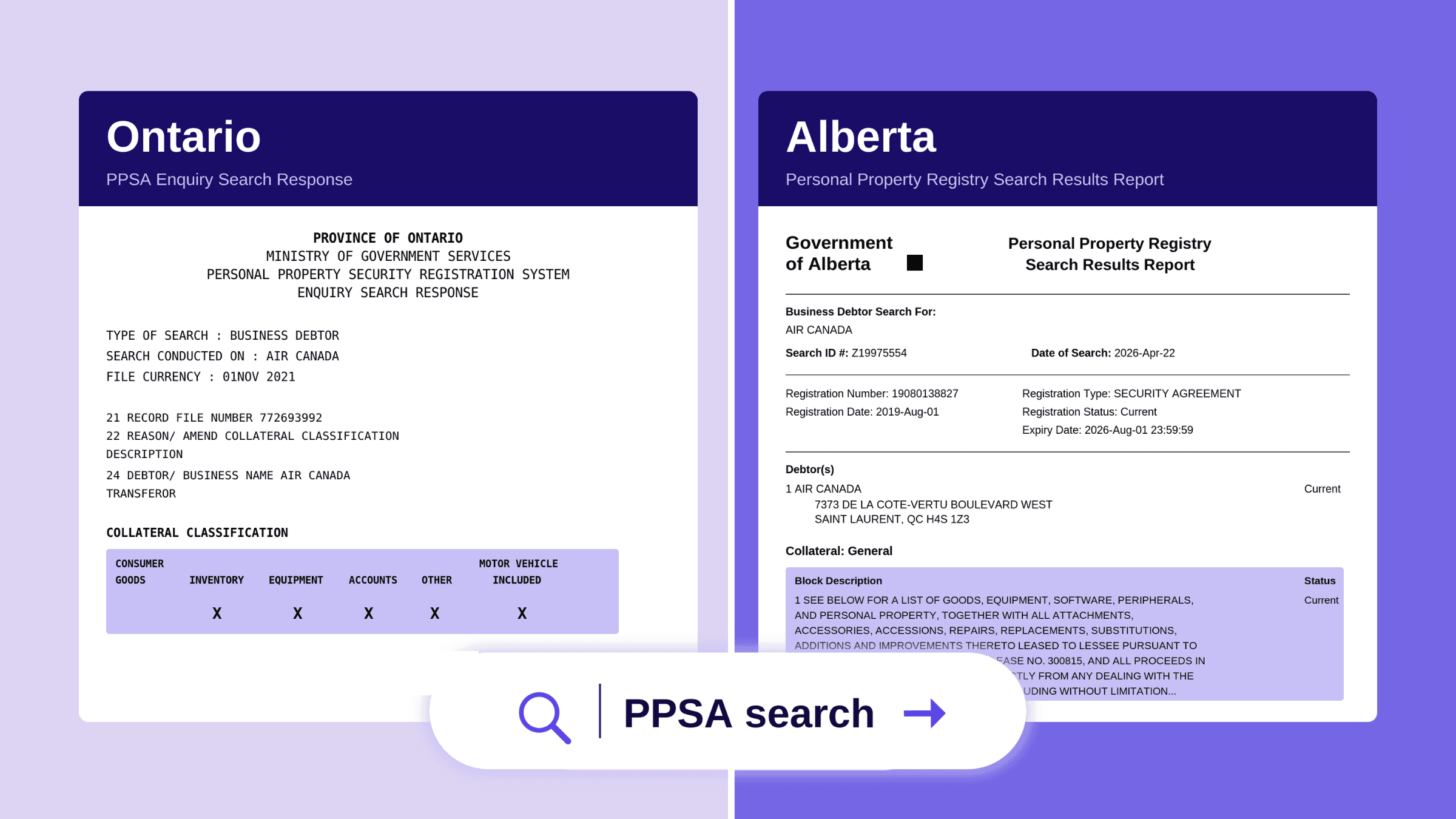
In Ontario, a PPSA search comes in two versions, certified and uncertified. Uncertified searches are generally referred to as “real-time” or “verbal” searches (a story for another time on where the term “verbal” originates…). The difference is in what happens if the search results turn out to be wrong and cause losses.
Section 44 of the Ontario PPSA provides for compensation to a person who suffers loss or damage after relying on a certificate of the Registrar (issued under s. 43 of the PPSA) that turns out to be incorrect. Without a certificate, there is nothing for that provision to attach to and therefore no compensation scheme available.
The Assurance Fund: what it is and how it is funded
The Assurance Fund exists to address one issue: what happens when the registry itself is the one that gets a certified search wrong.
The PPSA compensation scheme is backed by the Assurance Fund, which has existed since the mid-1970s. It is funded by 1% of applicable PPSA registration fees and is held as a trust account within the Consolidated Revenue Fund. Ontario describes its purpose consistently in its own financial statements: the fund is maintained to compensate persons who suffer loss or damage from incorrect information in a certificate. The fund is not limited to the PPSA; it also covers claims made under the Repair and Storage Liens Act (“RSLA”).
Ontario's dedicated fund model is not the standard Canadian approach. For example, Alberta, Saskatchewan, British Columbia, New Brunswick and Newfoundland and Labrador generally provide a statutory action against the Crown or the registrar for loss caused by an error or omission in the operation of the registry, rather than a segregated fund that accumulates registration fees.
Regardless of the structure, the practical outcome for a successful claimant may be similar across Canadian PPSA jurisdictions, subject to their varying respective claim limitations.
What the Assurance Fund actually covers
The Assurance Fund covers losses caused by an error inside the registry's own operations, not user search errors or errors in the information submitted by a registering party.
Section 44 of the PPSA provides for compensation where the person relied on a certificate that is incorrect because of an error or omission in the operation of the system of registration, recording and production of information. The error has to originate inside the registry's own operations. Errors in the information supplied by a registering party, or user search errors, fall outside the scheme, even though those errors are far more common in practice and can be just as damaging.
Federal Business Development Bank v. Ontario (Registrar of Personal Property Security), 1984 CanLII 3067 (ON HCJDC) **shows how narrow the Assurance Fund coverage is. The bank ran an individual specific search on the debtor's correct name, Raymond C. Verboncoeur. The search came back clear, and the bank lent. After the debtor went bankrupt, a non-specific search on "Raymond Verboncoeur" turned up two earlier chattel mortgages registered without the middle initial. The bank claimed against the fund for its $6,470 loss. The Master allowed the claim, but the Divisional Court reversed. The certificate reports against the name the searcher supplies, and choosing the right name and search type is the searcher's responsibility. The registry had reported exactly what it was asked, so the certificate was not incorrect and there was no error or omission in the system. The court also held that the earlier registrations were unperfected, so the bank had priority it never asserted.
How a claim works
Making a claim against the Assurance Fund is an administrative process rather than a lawsuit: you apply to the Registrar, and if the claim is accepted, you're paid out of the fund, with court only needed if you disagree with the outcome.
The process runs in four steps:
A claimant files an application with the Registrar. Claims must be made within one year from the time that the loss or damage giving rise to the claim came to the claimant’s knowledge.
The Registrar determines entitlement and, if the claim is accepted, makes an offer of settlement.
A claimant who disagrees with the determination or the offer can take the matter to court instead.
Once entitlement is finally determined, the Registrar certifies the amount to the Treasurer, who pays the claimant out of the fund.
Critically, the statute limits the maximum amount payable on successful claims. Compensation for claims relating to a single security agreement is subject to a limit of $1M (and only so far as the Assurance Fund is sufficient), which, practically speaking, is far below the value of significant commercial financings and M&A deals that many law firms advise on.
Amendments in 1998 allowed the Registrar to determine that a claimant is entitled to compensation without a hearing, though a hearing is still required before a claim is denied. This is relevant for anyone trying to research the fund's claims history, because a successful claim can be resolved from start to finish without generating a reported decision.
The fund's financial position
As at March 31, 2025, the Assurance Fund held $24,872,292, up from $20,023,532 a decade earlier, and there is no public record of a significant claim being paid out of it in that period.
Ontario reports the Assurance Fund under funds and other liabilities in its public accounts, showing an opening balance, net transactions and a closing balance for each year.
Over the ten fiscal years from April 1, 2015 to March 31, 2025, the fund grew from $20,023,532 to $24,872,292. Every year in that period shows a positive net transaction (with the exception of 2023-24, which shows net transactions of zero). The most recent year, 2024-25, shows net transactions of +$948,906.
It's worth qualifying that a positive net transaction in a year does not conclusively prove that no claim was paid in that year, because contributions and interest can exceed a modest payment.
Looking back, one possible expenditure we identified from the fund was $17,987 in 1984-85, recorded in Ontario's public accounts as a non-budgetary expenditure within the Ministry of Consumer and Commercial Relations' trust and special purpose accounts. The records do not say what the payment was for, who received it, or whether it related to the PPSA or the RSLA.
Why the original risk has changed
The Assurance Fund was designed to cover a kind of error that has largely disappeared in the modern electronic world: mistakes made by Ministry staff when manually entering paper registration forms into the registry.
When it was created, information from paper registration forms was retyped into the registry by Ministry staff. Later, paper forms were scanned. Both approaches placed the Ministry between the registering party and the record, and both created opportunities for the registry itself to introduce an error into the data that a certificate would later reproduce. Ontario's registry has since moved to largely electronic registration, in which the registering party transmits the information directly.
The Ontario Bar Association made this observation in its 2019 submission to the Business Law Modernization and Burden Reduction Council. It noted that the fund relates only to internal errors within the registry rather than errors in information supplied by registering parties, and that in a modern electronic system the original source of those errors has largely ceased to exist. It went on to suggest that the government look into whether the fund was being called upon with any frequency, or at all.
What this means in practice for lenders, buyers and their counsel
None of this makes ordering a certified Ontario PPSA search a poor decision. The cost is immaterial relative to the size of most commercial financing and M&A transactions, the certificate is a clean document for the closing record, and there is no reason to decline the statutory protection that comes with it (even if extremely narrow).
If a client or a lender wants certified searches, it’s an easy request to accommodate, though it comes with a timing tradeoff worth flagging up front: a certified search must be physically printed by the Ministry for the following business day, compared with near real-time results for an uncertified search (assuming the results are fewer than 40 pages long). On a time-sensitive closing, that lag is often a more immediate constraint than anything the Assurance Fund does or doesn't cover. Regy’s recommendation is generally to order both a certified PPSA search and a real-time uncertified PPSA search for a closing, to take advantage of both the speed of real-time and Assurance Fund coverage from the certified PPSA.
In our own experience running these searches, it's the scope and timing issues described above, not certification status, that most often lead to diligence gaps. For more on how those gaps arise, see our article on where search due diligence can go wrong on M&A and financing deals.
Frequently asked questions
What makes a PPSA search "certified" in Ontario?
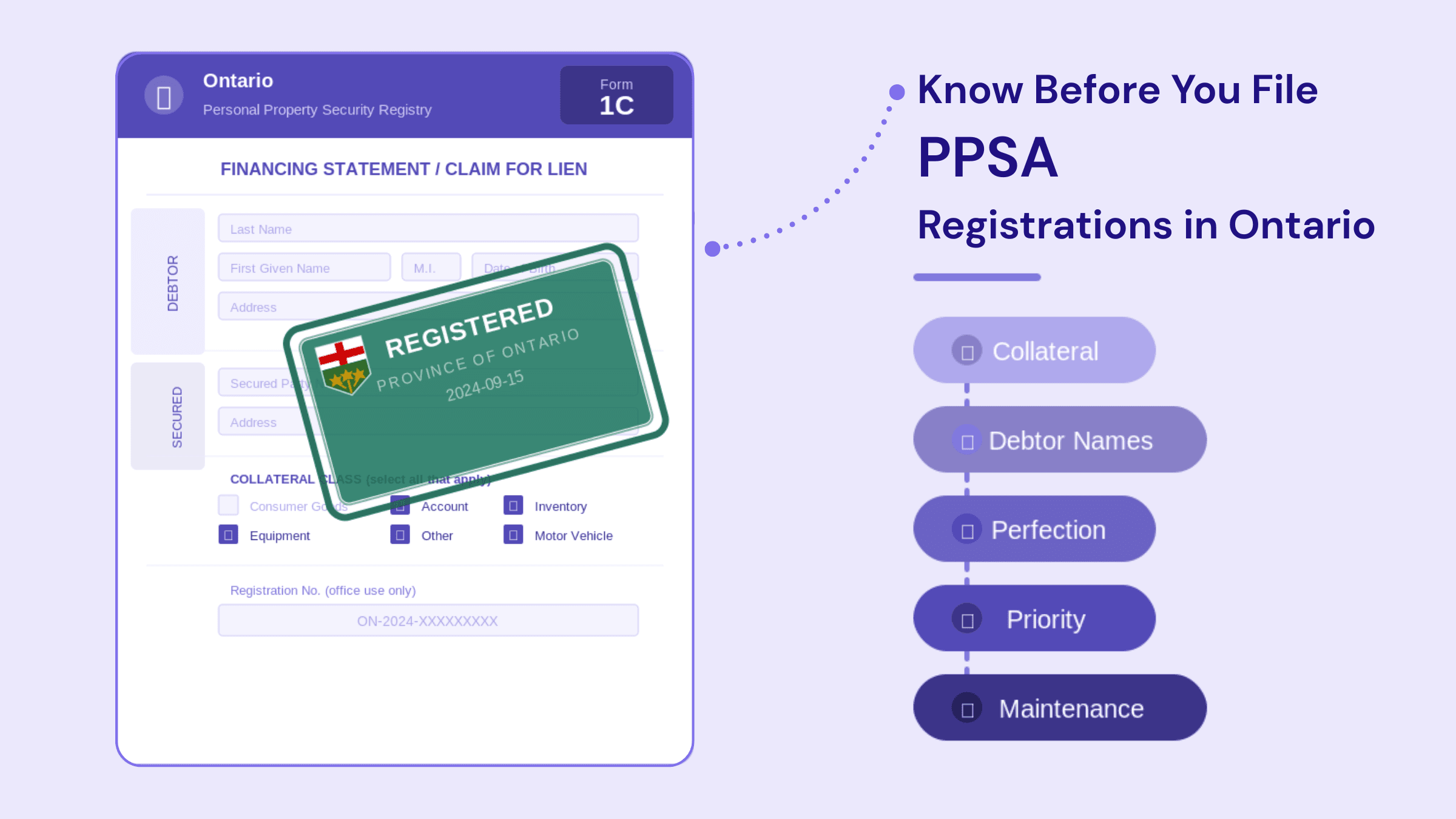
An Ontario PPSA search response is certified when it is issued under s. 43 of the PPSA, which can easily be identified by the Ministry certification stamp in the bottom right hand corner of the search.
It’s worth noting that (subject to the currency date of the search) a certified PPSA search will include registrations up until the end of the business day, whereas a real-time uncertified search (unless 40 pages or more of results) will include registrations on record as at the time of searching.
What does the PPSA Assurance Fund actually cover?
The Assurance Fund covers losses caused by an error inside the registry's own operations, such as a mistake in how a registration was recorded or produced in a certified search. It does not cover errors in the information submitted by a registering party, or from a user’s erroneous or incomplete searches.
How long does a certified search take compared to an uncertified one?
A certified search typically takes one business day to process as the Ministry must physically print out the search before service providers can pick it up for scanning. An uncertified search returns results in a couple of minutes during registry hours, unless the results are 40 or more pages long (at which point, they are produced “overnight” and returned the following business day).
So what does certification actually get you in Ontario?
In short: a certified Ontario PPSA search buys you access to a compensation scheme for internal registry operational errors.
The practical utility of the compensation scheme is, however, severely limited by the maximum amount payable for a claim (i.e., $1M per security agreement and only so long as the Assurance Fund is sufficient) and the narrow and unlikely causes of potential internal errors with an electronic registry.
Caveat: this article describes the Ontario certified PPSA search and Assurance Fund framework in general terms. It is not a full account of sections 43 and 44 of the PPSA, the associated regulations, uncertified PPSA types, or the compensation provisions of other Canadian PPSA jurisdictions, each of which has its own requirements and limits.
The information provided on this website is for general information purposes only and does not constitute legal advice. It is not intended to be a substitute for legal advice from a qualified lawyer. Regy is not a law firm.