
Key takeaways
A collateral classification selection is mandatory in Ontario, but a general collateral description is optional and will limit the scope of your registration if included.
The “amount secured” field should only be completed if consumer goods are included as a collateral classification - consumer goods are rarely selected in a commercial context.
The debtor name is the most critical field in a financing statement, and errors will likely result in a loss of perfection.
Motor vehicle descriptions are optional in most cases but strongly recommended when vehicles form a material part of the collateral.
Maintenance obligations begin the moment a registration is filed, and deadlines for amendments and renewals are strictly enforced.
Under the Ontario Personal Property Security Act (”PPSA”), perfecting a security interest by registration requires filing a financing statement with Ontario's Personal Property Security Registry. Registrations can be filed before or after the security agreement is signed, with one important exception: if consumer goods are included as collateral, the financing statement must be filed after the debtor has signed the security agreement.
Most of the nuances with Ontario PPSA registrations come down to how the fields are completed, and understanding the rules behind them.
Which collateral classes must you select - and should you add a collateral description?
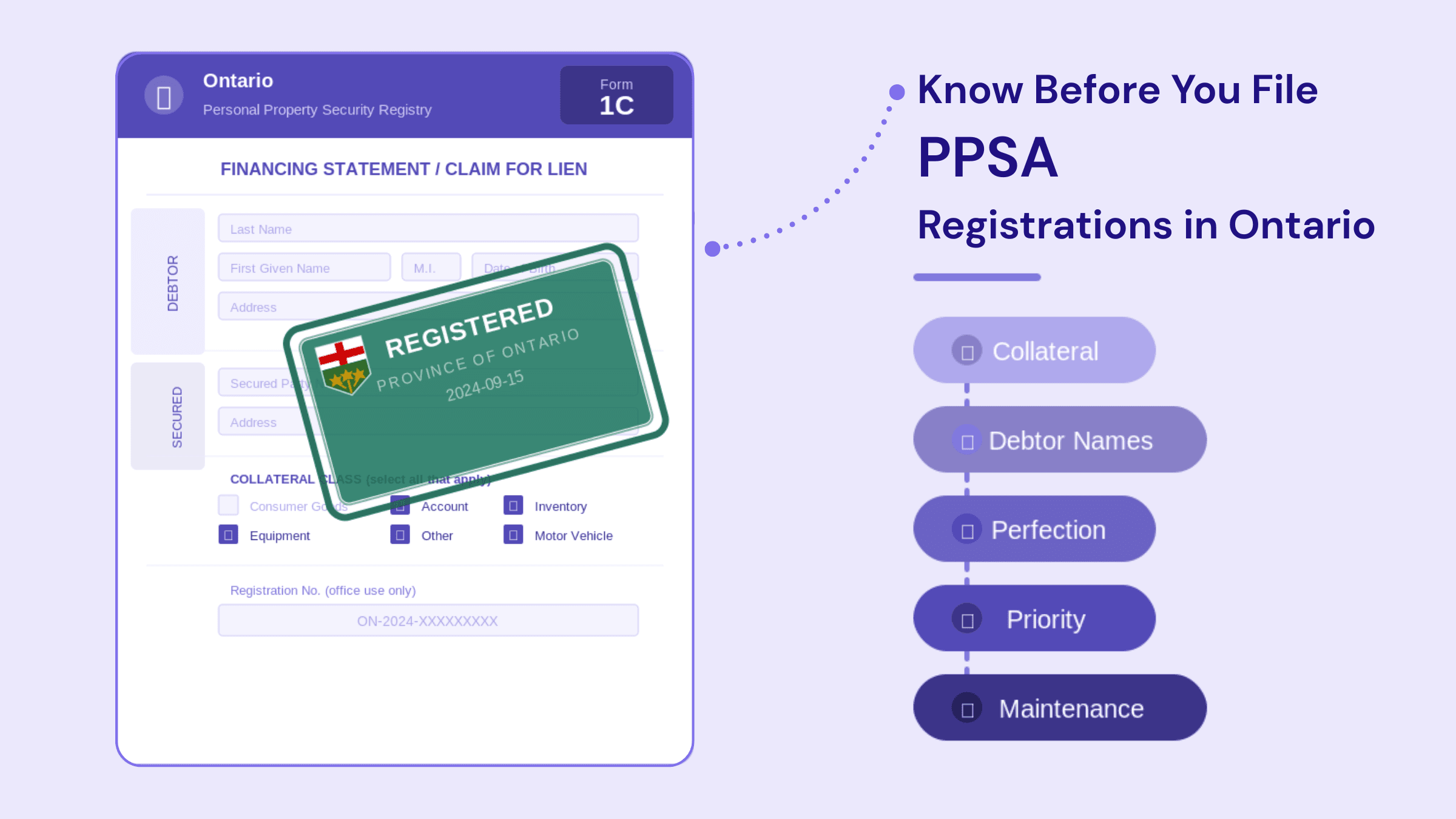
One of the distinctive features of Ontario's PPSA system is that selecting a collateral class is mandatory. There are five classes: Consumer Goods, Inventory, Equipment, Accounts, and Other. Secured parties must select at least one.
The classification depends on how the collateral is used in the hands of the debtor. Inventory covers goods held for sale or lease and raw materials or work in process. Equipment covers goods that are not inventory or consumer goods. Accounts covers receivables not evidenced by chattel paper or an instrument. Other is a catch-all and should always be checked in addition to any other applicable category, since it captures certain classes of proceeds that would not otherwise fall within a named class. If motor vehicles are or may be included in the collateral, the Motor Vehicle Included indicator should be selected regardless of whether specific vehicles are described elsewhere in the registration.
Providing a general collateral description, by contrast, is optional. In practice, most Ontario commercial lending registrations leave this field blank. The reason is straightforward: including a general collateral description limits the collateral as specifically described. A description that is too narrow can inadvertently exclude collateral the security agreement was meant to include. If a general collateral description is included, it should be drafted carefully and broadly enough to cover all collateral charged by the agreement, including parts, accessories, attachments, and proceeds.
Do not complete the “amount secured” field unless the collateral classes include consumer goods. For standard commercial transactions, this field is typically left blank.
What name must you use for the debtor on an Ontario PPSA registration?
No field in a financing statement is more consequential than the debtor name. An error here will, in most cases, result in a loss of perfection.
For corporations, the name must match the entity's articles of incorporation or equivalent document exactly. If the articles include a French or English alternate name, that alternate name (the combined French / English and English / French versions are also recommended) must be listed as a separate debtor on the registration.
For individuals, the name must be drawn from a birth certificate issued by a Canadian province or territory, or from citizenship papers for those born outside Canada. A driver’s licence should not be relied on as the source for an individual debtor’s name.
Where there is uncertainty about the correct name, including situations where documentation discloses two possible variations, the recommended approach is to register against each variation as a separate debtor.
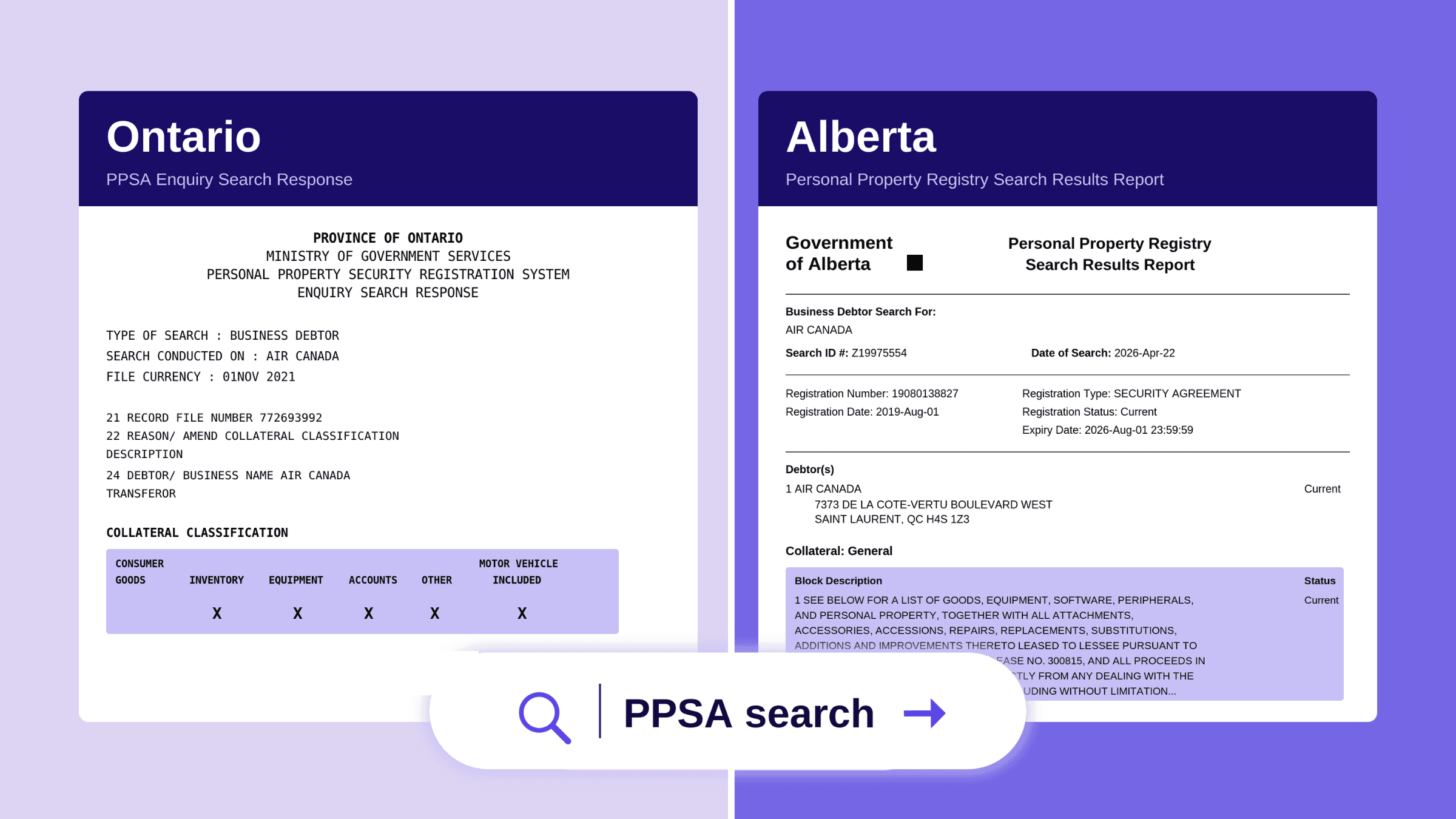
Debtor name accuracy is equally critical on the search side, as small differences in how a name is entered can cause results to be missed entirely. To learn more about how name errors affect search results, read our articles: Where Search Due Diligence Can Go Wrong on M&A and Financing Deals and How PPSA Searches Differ Between Ontario and Nova Scotia.
Motor vehicle descriptions
Including a motor vehicle description is optional unless the vehicle is classified as consumer goods, in which case it is mandatory. Even where optional, completing this section is strongly recommended when vehicles form a material part of the collateral. If an error is made in the debtor name, a security interest in a motor vehicle remains perfected if the VIN is correctly recorded in the motor vehicle description. Additionally, a bona fide purchaser for value without notice can take a motor vehicle free and clear of a security interest if the vehicle was not described in the registration. Each vehicle description must include the VIN, model year, model, and make or manufacturer name.
How long should your PPSA registration last, and what are your post-filing obligations?
The registration period must be expressed in whole years between one and 25, or designated as perpetual (which shows up as 99 years). Most secured parties select a period that extends one to two years beyond the maturity of the underlying obligation, including any automatic renewals. A registration expires automatically at the end of its stated period and cannot be renewed after it has lapsed.
Maintenance obligations begin as soon as a registration is filed. If a debtor changes its name, a financing change statement must be filed within 30 days of the secured party learning both the fact of the name change and the new name. If the debtor's location moves into Ontario from another jurisdiction, a financing change statement must be filed within the earliest of 60 days of the relocation, 15 days of receiving notice of the relocation, or the day perfection ceases under the prior jurisdiction's law. After any filing, secured parties should verify the verification statement for accuracy and record the registration's expiry date.
Regy allows secured parties to easily register financing statements in real time, track expiry dates, and file renewals, amendments, and discharges directly as circumstances change, reducing the risk of missed deadlines and filings across a firm’s portfolio of registrations.
The information provided on this website is for general information purposes only and does not constitute legal advice. It is not intended to be a substitute for legal advice from a qualified lawyer. Regy is not a law firm.